








What Is the Function of a Rotor in a Laboratory Centrifuge?
The centrifuge rotor is a critical component that directly determines how centrifugal force is applied to laboratory samples. By defining sample position, sedimentation path, and effective force distribution, the rotor governs separation efficiency, reproducibility, and sample integrity
Abstract
In laboratory centrifugation, the rotor is the central mechanical component that directly governs separation efficiency, sample integrity, and experimental reproducibility. Although often treated as a secondary accessory, rotor geometry, capacity, and material properties fundamentally determine how centrifugal force is applied to a sample. This article examines the functional role of the centrifuge rotor from a scientific and operational perspective, explaining how it converts rotational motion into effective separation and why rotor selection is critical for reliable laboratory workflows.
1. Introduction
Centrifugation is a cornerstone technique in clinical diagnostics, biotechnology, molecular biology, and analytical laboratories. While parameters such as speed (RPM) and relative centrifugal force (RCF) are frequently discussed, these parameters only become meaningful through the rotor. The rotor is the interface between the centrifuge motor and the sample, translating angular velocity into a directed force field that drives sedimentation.
From a research standpoint, understanding the rotor’s function is essential to avoid common methodological errors, including incomplete separation, sample remixing, or structural damage to biological material.
2. Mechanical Role of the Rotor
At its core, a centrifuge rotor serves three primary mechanical functions:
-
Sample Positioning
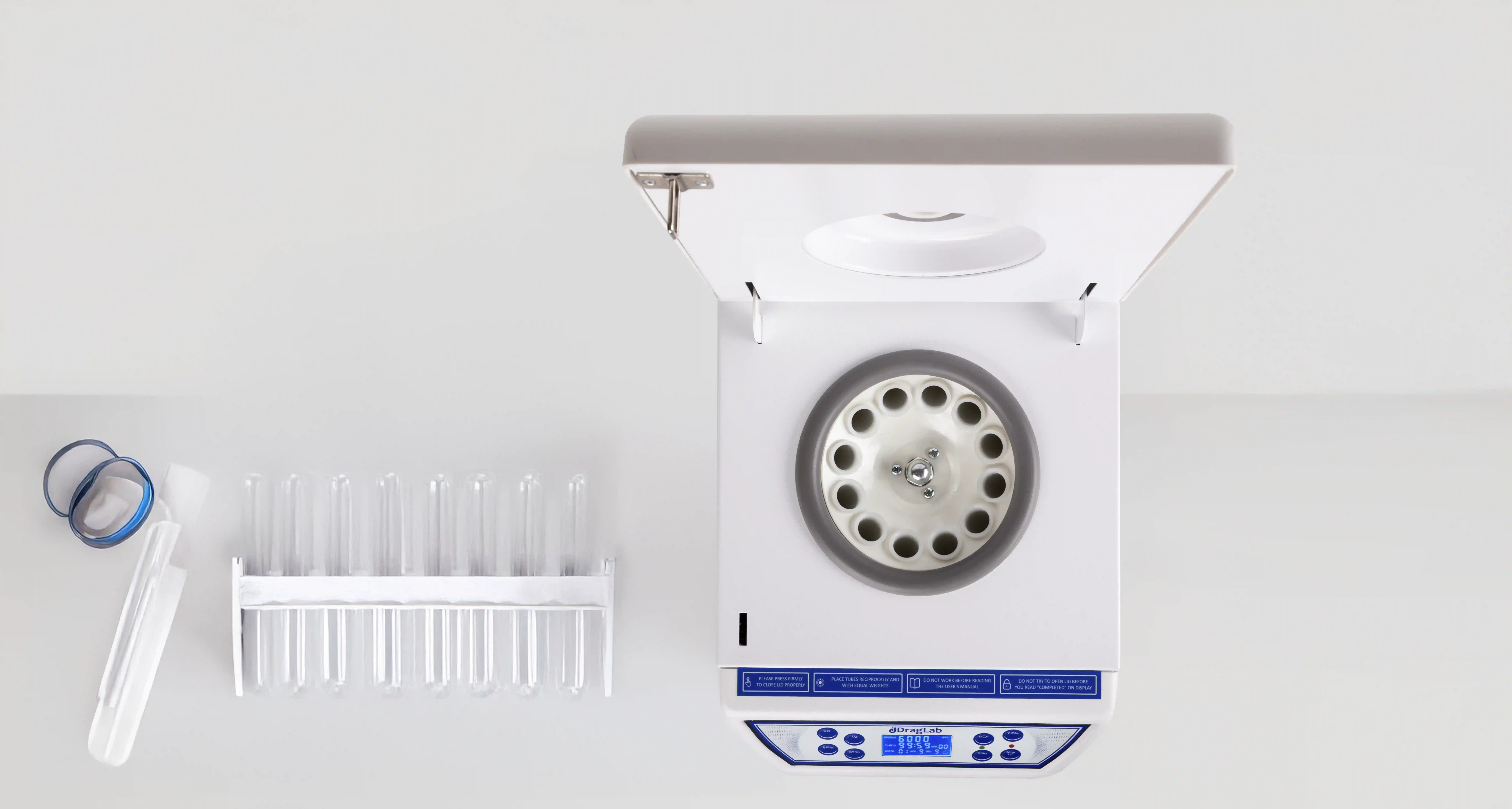
The rotor holds tubes, bottles, or adapters at a defined angle and radius relative to the axis of rotation. This geometry determines the sedimentation path length and direction of particle movement. -
Force Transmission
Centrifugal force is proportional to both rotational speed and the radial distance of the sample from the axis. The rotor defines this radius, thereby directly influencing the effective RCF experienced by the sample. -
Dynamic Stability
During operation, the rotor must maintain precise balance under high rotational stress. Proper rotor design minimizes vibration, protects bearings and motors, and ensures consistent force distribution across all samples.
Without a properly engineered rotor, even a high-performance centrifuge cannot deliver accurate or reproducible results.
3. Rotor Geometry and Separation Behavior
The geometry of a rotor dictates how particles migrate and where the final pellet forms:
-
Fixed-angle rotors position tubes at a constant incline, causing particles to sediment along the sidewall before collecting at the bottom edge of the tube.
-
Swing-out rotors allow tubes to move into a horizontal position during rotation, enabling particles to sediment directly to the tube bottom along a uniform path.
These geometric differences affect separation time, pellet compactness, and ease of supernatant removal. Therefore, rotor selection should be aligned with the physical properties of the sample rather than convenience alone.
4. Impact on Sample Integrity
From a biological perspective, the rotor plays a decisive role in sample preservation:
-
Shear stress is influenced by acceleration and deceleration profiles, which interact with rotor mass and design.
-
Pellet compression varies depending on sedimentation angle and force distribution.
-
Thermal effects may arise at high speeds if rotor materials and airflow are poorly optimized.
For sensitive samples such as blood components, cells, or nucleic acids, inappropriate rotor choice can lead to hemolysis, cell rupture, or loss of analytical accuracy.
5. Safety and Compliance Considerations
Rotors are among the most highly stressed components in a centrifuge system. For this reason:
-
They must be manufactured from materials capable of withstanding repeated high-g cycles.
-
They require precise machining to prevent imbalance.
-
They must comply with international safety and laboratory equipment standards.
Routine inspection and adherence to manufacturer load limits are not optional practices; they are fundamental safety requirements in regulated laboratory environments.
6. Practical Implications for Laboratory Workflows
In daily laboratory operations, the rotor determines:
-
Maximum tube volume and configuration
-
Throughput per run
-
Compatibility with standardized consumables
-
Reproducibility between runs and between laboratories
Consequently, rotors should be treated as application-specific scientific tools rather than interchangeable mechanical parts.
7. Conclusion
The rotor is the functional heart of a laboratory centrifuge. It defines how centrifugal force is applied, how samples behave during separation, and how reproducible and safe the process will be. A clear understanding of rotor function enables researchers and laboratory professionals to make informed decisions, reduce experimental variability, and maintain high standards of analytical reliability.
In subsequent articles, we will build on this foundation by examining how rotor design interacts with speed, RCF, and sample volume to further influence centrifugation outcomes.
Need help choosing? Contact DragLab today to get a tailored recommendation based on your application.
📧 Email: info@drag-lab.de
🌐 Browse all models: www.drag-lab.de